


RACS Exam Australia is one of the most important pathways for International Medical Graduates (IMGs) and overseas-trained surgeons who want to obtain specialist recognition and build a surgical career in Australia or New Zealand. Managed by the Royal Australasian College of Surgeons, the Royal Australasian College of Surgeons is designed to assess surgical knowledge, clinical reasoning, technical skills, patient safety awareness, and professional communication within the Australian healthcare system.
Understanding the GSSE exam structure, RACS eligibility requirements, specialist assessment process, and FRACS training pathway is essential for international surgeons preparing for surgical registration and specialist practice in Australia. Many candidates struggle because they underestimate the depth of the RACS curriculum, rely on outdated study methods, or fail to adapt to Australian surgical standards and examiner expectations.
Successfully progressing through the RACS Exam Australia pathway requires structured preparation, discipline, and practical clinical experience. Candidates preparing for the GSSE exam, FRACS clinical assessments, and FRACS specialist training should focus on updated RACS surgical study resources, evidence-based guidelines, mock viva practice, and real-life surgical case discussions.
International surgeons who improve communication skills, understand multidisciplinary teamwork, and practice clinical decision-making under pressure are usually better prepared for specialist assessment and workplace-based evaluations. This guide provides a complete breakdown of the FRACS pathway, GSSE exam format, pass rates, eligibility requirements, and preparation strategies to help overseas-trained surgeons improve confidence, avoid common mistakes, and increase their chances of achieving RACS specialist recognition in surgery Australia.
Understanding the FRACS Pathway
Understanding the FRACS pathway is essential for International Medical Graduates (IMGs) and overseas surgeons who want to become certified surgeons in Australia or New Zealand. Managed by the Royal Australasian College of Surgeons, the Fellowship of the Royal Australasian College of Surgeons pathway is designed to assess surgical knowledge, clinical competence, operative skills, communication abilities, and professional standards within the Australian healthcare system.
The process usually begins with meeting FRACS eligibility requirements, completing primary source verification, English language requirements, and obtaining appropriate medical registration. Candidates then progress through the RACS IMG pathway, which may include competency assessments, workplace-based evaluations, and RACS specialist assessment reviews before entering the FRACS training pathway.
Understanding the RACS examination structure, including the RACS Generic Surgical Sciences Examination (GSSE Exam Australia), RACS written exam, RACS anatomy exam, RACS clinical examination, and RACS operative surgery assessment, is very important for doctors preparing for surgical fellowship Australia.
The FRACS pathway follows a structured step-by-step process that requires both academic preparation and RACS practical surgical experience. First, candidates must build strong foundational knowledge through basic surgical training Australia and preparation for the GSSE exam, which focuses heavily on anatomy, pathology, physiology, and clinical sciences. After successfully completing this stage, doctors progress into advanced surgical training Australia, where they develop RACS operative decision-making, RACS technical surgical skills, and RACS multidisciplinary teamwork experience.
Many overseas surgeons struggle because they focus only on theoretical study while neglecting RACS practical clinical cases, RACS viva preparation, and communication skills needed during the RACS Clinical Exam and RACS operative skills assessment. Candidates who use updated RACS study guides, practice mock exams regularly, attend surgical skills courses, and participate in RACS preparation courses are often better prepared for specialist assessment and FRACS specialist recognition.
Consistent preparation, understanding Australian surgical standards, and strong clinical reasoning are usually the key factors for long-term success in the Australian surgeon licensing pathway.
RACS Exam Eligibility Requirements for International Surgeons
Understanding the RACS exam eligibility requirements is one of the first and most important steps for International Medical Graduates (IMGs) and overseas surgeons pursuing specialist recognition in Australia. The eligibility process managed by the Royal Australasian College of Surgeons is designed to ensure that candidates meet Australian surgical standards before entering the FRACS pathway or specialist assessment process. The pathway usually begins with primary source verification, proof of medical qualifications, English language proficiency requirements such as IELTS or OET, and medical registration eligibility through the Australian Medical Council process.
Candidates must also submit detailed surgical training records, employment history, operative experience logs, continuing professional development documents, and references for RACS competency assessment. Depending on the assessment outcome, international surgeons may be considered substantially comparable, partially comparable, or require additional training before progressing through the FRACS training pathway and Australian surgeon licensing pathway.
Many overseas surgeons Australia struggle during the eligibility process because they underestimate the importance of proper documentation, recent surgical experience, and understanding the RACS examination structure. One common challenge is incomplete surgical logbooks or poorly organized operative records, which can delay specialist assessment or affect eligibility decisions. For example, a highly experienced general surgeon may still face difficulties if their clinical documentation does not clearly demonstrate operative independence, surgical case diversity, or recent professional development activities according to Australian standards.
Practical solutions include organizing all training certificates early, maintaining accurate operative surgery records, participating in RACS preparation courses, and seeking mentorship from surgeons already familiar with the FRACS specialist recognition process. Candidates who actively prepare for the GSSE Exam Australia, improve communication skills, and gain supervised clinical exposure within the Australian healthcare system are usually better positioned for long-term success in the RACS IMG pathway and surgical fellowship Australia.
RACS GSSE Exam Pass Rates
Understanding the RACS GSSE Exam pass rates is very important for International Medical Graduates (IMGs) and doctors preparing for the FRACS pathway because the examination is widely known for its difficulty and high academic standard. The Royal Australasian College of Surgeons reports that the RACS Generic Surgical Sciences Examination (GSSE Exam Australia) assesses anatomy, pathology, and physiology with strict minimum component scores and an overall passing standard. Recent RACS activity reports show overall GSSE pass rates commonly ranging around 55% to 60% for many candidate groups, although results vary between exam sittings and specialties.
Anatomy contributes approximately 50% of the total assessment, while pathology and physiology each contribute about 25%, making anatomy performance one of the biggest factors influencing success in the RACS written exam. Many candidates fail not because of poor overall performance, but because they fail one individual component despite achieving a reasonable total score.
Several factors strongly influence RACS exam pass rates, including inconsistent preparation, poor anatomy knowledge, weak time management, and reliance on outdated study materials. Discussions among surgical trainees on Reddit and Australian medical forums frequently highlight that many candidates underestimate the depth of the GSSE syllabus and the level of detail required for anatomy and clinical sciences. One common real-life example is candidates focusing heavily on question banks while neglecting core surgical textbooks and structured revision, leading to weak understanding during complex surgical science questions.
Practical strategies that consistently improve performance include following a structured RACS study guide, using updated GSSE preparation resources, practicing mock exams regularly, revising anatomy daily with visual learning tools, and reviewing weak subjects early before the examination. Many successful candidates also recommend combining question banks with detailed anatomy references, clinical discussion groups, and RACS preparation courses to improve retention and exam confidence.
Doctors who treat the GSSE exam as a long-term preparation process rather than a short-term revision exercise are usually more likely to pass the RACS surgical exam and progress successfully through the FRACS training pathway.
RACS Exam Study Resources for GSSE Preparation
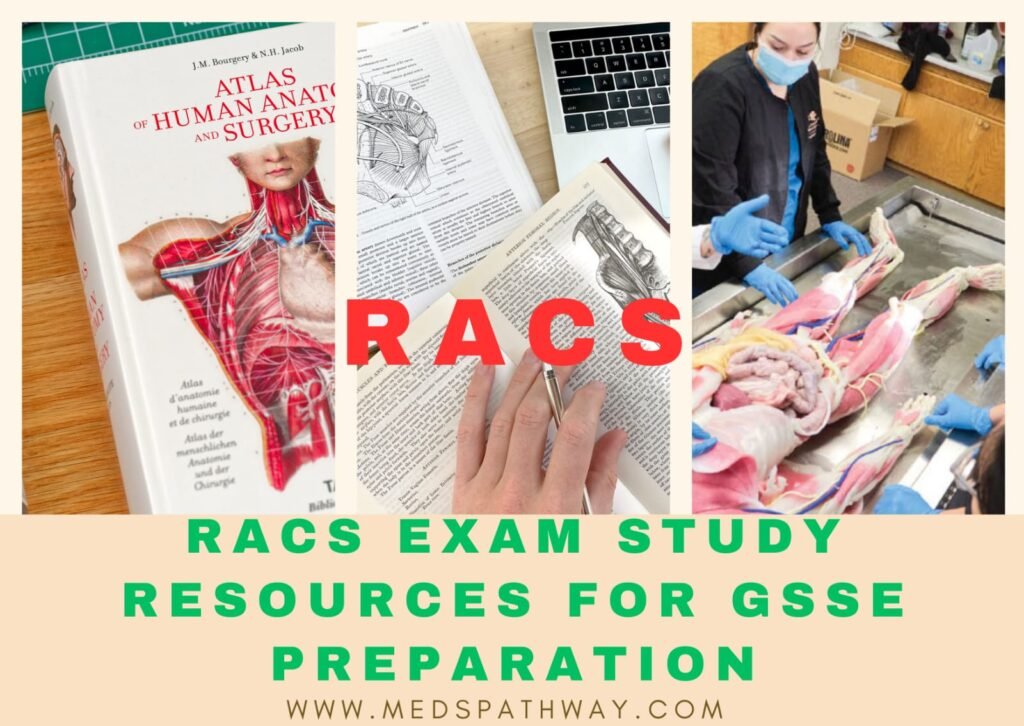
Preparing for the RACS Generic Surgical Sciences Examination (GSSE Exam Australia) requires high-quality and updated study resources because the examination is designed to assess modern surgical science knowledge according to current Australian surgical standards. Candidates preparing for the RACS surgical exam and FRACS pathway must study anatomy, pathology, physiology, and clinical sciences using reliable materials that reflect the current RACS exam syllabus and examination structure.
Many International Medical Graduates (IMGs) and surgical trainees struggle because they depend on outdated notes, old recall questions, or incomplete summaries that no longer match the evolving standards of surgical education and training Australia. Updated RACS study guides, anatomy atlases, physiology textbooks, pathology references, online surgical question banks, and mock exams help candidates build stronger clinical reasoning and improve performance during the RACS written exam and RACS anatomy exam.
Using current study resources is especially important because surgical practice, patient safety standards, and examination expectations continue to change over time.
One major challenge during GSSE preparation is information overload, where candidates attempt to study too many resources without a structured revision plan. This often leads to confusion, burnout, and weak retention of core surgical concepts. For example, a candidate may spend months reviewing random anatomy facts but still struggle during clinical application questions because they failed to connect anatomy with surgical scenarios and operative decision-making. Practical strategies that work well include following a realistic study timetable, focusing on high-yield GSSE topics, using active recall methods, practicing RACS mock exams regularly, and reviewing weak subjects early in the preparation process.
Many successful candidates preparing for the FRACS Exam also benefit from joining RACS preparation courses, study groups, anatomy revision sessions, and surgical skills workshops to improve understanding and accountability. Candidates who combine updated study resources with disciplined revision, repeated practice questions, and structured clinical learning are usually better prepared to pass the RACS exam and progress successfully through the FRACS training pathway.
General Surgical Science Examination (GSSE) Overview
The General Surgical Science Examination (GSSE) is one of the most important stages in the FRACS pathway for International Medical Graduates (IMGs) and surgical trainees pursuing specialist recognition in Australia and New Zealand. Conducted by the Royal Australasian College of Surgeons, the RACS Generic Surgical Sciences Examination (GSSE Exam Australia) is designed to assess foundational surgical science knowledge required for safe surgical practice and advanced surgical training Australia. The examination mainly focuses on anatomy, pathology, and physiology, with anatomy carrying the highest weighting in the RACS written exam.
Candidates preparing for the RACS surgical exam are expected to demonstrate a strong understanding of surgical anatomy, disease processes, organ system function, wound healing, trauma response, infection control, and perioperative patient management according to Australian surgical education standards. Understanding the RACS examination structure, exam syllabus, and assessment format is essential for doctors planning to progress through the FRACS training pathway and Australian surgical fellowship exam process.
The GSSE exam follows a structured assessment format that tests both theoretical understanding and clinical application of surgical sciences. Candidates usually begin preparation by reviewing core anatomy references, pathology textbooks, physiology concepts, and clinical surgical scenarios relevant to general surgery training Australia and surgical fellowship Australia. Many overseas surgeons Australia struggle because they underestimate the level of detail required for the RACS anatomy exam and fail to practice applying surgical science knowledge to real-life clinical cases.
For example, a candidate may memorize anatomical structures but struggle to answer operative surgery questions involving surgical approaches, complications, or emergency decision-making. Effective GSSE preparation often includes structured RACS study guides, mock exams, anatomy revision sessions, question banks, surgical preparation courses, and active recall study techniques. Candidates who consistently practice RACS clinical cases, review weak subjects early, and maintain a disciplined revision schedule are usually better prepared to pass the GSSE exam and continue successfully through the FRACS specialist recognition pathway.
Importance of Thorough Preparation in the RACS Exam Australia
Thorough preparation is one of the most important factors for success in the RACS Exam Australia because the FRACS pathway is designed to assess not only theoretical knowledge but also clinical reasoning, operative judgment, communication skills, and patient safety according to Australian surgical standards. International Medical Graduates (IMGs) and overseas surgeons preparing for the RACS surgical exam, GSSE Exam Australia, and FRACS clinical examination must understand that the assessment process is highly competitive and academically demanding.
Effective preparation usually begins with understanding the RACS examination structure, reviewing the RACS exam syllabus carefully, and creating a realistic study plan covering anatomy, pathology, physiology, operative surgery principles, and clinical surgical cases. Many candidates struggle because they study inconsistently, rely only on old recall questions, or fail to practice applying knowledge in real surgical scenarios. Using updated RACS study guides, mock exams, anatomy revision tools, and surgical preparation courses can significantly improve understanding and performance during the RACS written exam and operative surgery assessment.
One common weakness during the preparation process is poor balance between theoretical revision and practical clinical preparation. For example, some candidates perform well in anatomy and physiology but struggle during RACS viva preparation or OSCE discussions because they lack confidence in explaining surgical decision-making under pressure. Another major challenge is poor time management, where doctors attempt to cover too many resources without mastering high-yield topics.
Practical strategies that consistently work well include daily structured revision, regular practice of RACS clinical cases, participation in surgical study groups, and simulated viva examinations with mentors or senior surgeons. Candidates preparing for the FRACS pathway should also focus on communication skills, multidisciplinary teamwork, and evidence-based surgical guidelines because these areas are heavily assessed during specialist assessment and RACS competency evaluations.
Surgeons who approach the Australian surgical fellowship exam with discipline, consistency, and practical preparation are usually more likely to pass the RACS exam on the first attempt and progress successfully toward FRACS specialist recognition and a long-term surgical career Australia.
Tips for Success in the RACS Exam

Success in the RACS Exam requires much more than memorizing surgical textbooks or reviewing old exam recalls. International Medical Graduates (IMGs) and overseas surgeons preparing for the FRACS Exam, GSSE Exam Australia, RACS Clinical Exam, and operative surgery assessments must develop strong clinical reasoning, surgical decision-making, communication skills, and time management abilities. One of the biggest weaknesses candidates face during the FRACS pathway is inconsistent preparation and poor understanding of the RACS examination structure.
Many doctors spend months studying random materials without following a structured RACS study guide or focusing on the actual RACS exam syllabus. Others struggle during RACS viva preparation and clinical case discussions because they lack confidence explaining operative management plans, anatomy concepts, or emergency surgical decisions under pressure. Successful candidates usually perform regular mock exams, review high-yield anatomy daily, practice RACS clinical cases consistently, and use updated surgical education and training Australia resources to strengthen both theoretical and practical knowledge.
Another major challenge in the Australian surgical fellowship exam pathway is balancing exam preparation with demanding hospital responsibilities and adapting to Australian healthcare standards. For example, a surgeon may have excellent operative experience overseas but still perform poorly during the RACS competency assessment because of weak communication skills, unfamiliarity with Australian clinical protocols, or lack of structured OSCE preparation. This is where Meds Pathway becomes a valuable solution for international doctors pursuing FRACS specialist recognition and surgical career Australia opportunities.
Meds Pathway helps candidates navigate the RACS IMG pathway with professional guidance, structured preparation strategies, mentorship support, updated study resources, interview preparation, and personalized assistance for the FRACS training pathway. Doctors who receive proper mentorship, consistent preparation support, and practical exam-focused guidance are usually more confident, more organized, and better prepared to pass the RACS exam on the first attempt and progress successfully toward becoming certified surgeons in Australia.
Strategic Study Tips to Excel in the GSSE Exam

Strategic preparation is essential to excel in the GSSE Exam Australia because the RACS Generic Surgical Sciences Examination is one of the most academically demanding stages in the FRACS pathway. International Medical Graduates (IMGs) and surgical trainees preparing for the RACS surgical exam should focus heavily on anatomy, pathology, and physiology, as these are the core components of the RACS written exam and strongly influence overall pass rates. Anatomy is usually the highest-weighted section and often becomes the biggest weakness area for many candidates.
To improve performance, doctors should use structured RACS study guides, anatomy atlases, active recall methods, flashcards, mock exams, and regular surgical question banks instead of relying only on passive reading. Candidates aiming to pass the GSSE exam should target strong and balanced performance across all sections because the RACS examination structure requires minimum component scores in addition to the overall passing mark. Many candidates fail despite reasonable total scores because they underperform in anatomy or another key component of the FRACS Exam syllabus.
One of the most effective study methods for success in the Australian surgical fellowship exam is combining daily revision with practical clinical application and timed exam practice. For example, candidates who consistently review surgical anatomy alongside operative surgery cases and physiology concepts often retain information better than those memorizing isolated facts. Common weaknesses during GSSE preparation include inconsistent study schedules, poor time management, lack of mock exam exposure, and studying outdated materials that no longer reflect current surgical education and training Australia standards.
This is where Meds Pathway provides a major advantage for overseas surgeons Australia and doctors pursuing FRACS specialist recognition. Meds Pathway supports candidates with structured GSSE preparation strategies, updated study resources, mentorship, mock exam guidance, RACS viva preparation support, and personalized coaching designed to help doctors pass the RACS exam on the first attempt. Candidates who combine disciplined preparation with expert guidance and consistent revision are usually better prepared for long-term success in the FRACS training pathway and surgical career Australia.
RACS Practical Exam Strategies
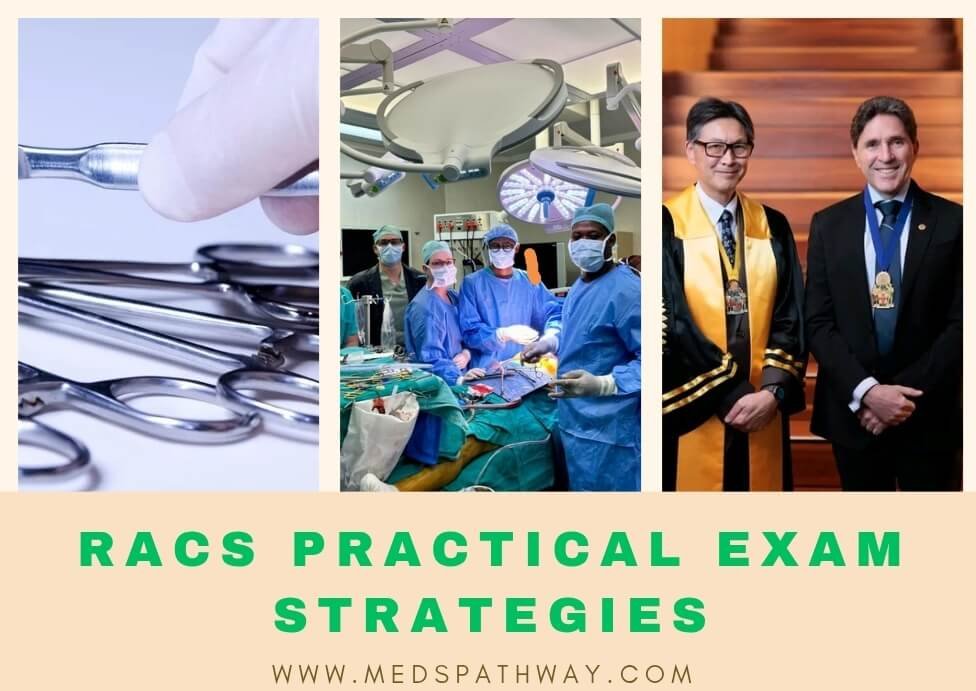
Success in the RACS practical exams requires more than theoretical knowledge because the FRACS pathway is designed to assess real surgical decision-making, operative judgment, communication skills, and patient safety under pressure. International Medical Graduates (IMGs) and overseas surgeons preparing for the RACS Clinical Exam, operative surgery exam, OSCE assessments, and FRACS clinical examination should focus heavily on surgical anatomy application, emergency management, clinical reasoning, operative planning, and structured patient communication.
One of the biggest focus areas during the Australian surgical fellowship exam is the ability to explain surgical management clearly and safely while demonstrating professionalism and confidence. Candidates preparing for the RACS viva examination and operative skills assessment should practice structured responses using clinical scenarios, mock surgical cases, multidisciplinary discussions, and evidence-based management guidelines. The RACS examination structure usually requires candidates to achieve minimum passing standards across multiple sections, meaning weak performance in one component can affect the final outcome even if the overall score appears reasonable.
Many candidates struggle during the RACS practical assessments because they focus only on memorization instead of practical application and communication under exam conditions. For example, a surgeon may know the technical management of bowel obstruction or trauma surgery but fail to communicate priorities, risks, and operative planning clearly during viva discussions or OSCE stations. Effective preparation strategies that consistently improve performance include participating in RACS mock exams, practicing surgical clinical cases daily, attending surgical skills workshops, improving time management, and rehearsing structured viva responses with mentors or colleagues.
This is where Meds Pathway provides major support for doctors pursuing FRACS specialist recognition and the RACS IMG pathway. Meds Pathway helps candidates prepare through personalized coaching, practical exam-focused strategies, updated RACS study resources, mock viva preparation, and structured mentorship tailored to the RACS surgical exam process. Candidates who combine consistent clinical practice with expert guidance and realistic exam preparation are usually more confident and more likely to pass the RACS exam successfully on their first attempt.
Analyzing the RACS Exam Pass Rates and Implications for candidates
Understanding RACS exam pass rates is very important for International Medical Graduates (IMGs) and overseas surgeons preparing for the FRACS pathway because these statistics reveal how competitive and demanding the Australian surgical fellowship exam process can be. Reports published by the Royal Australasian College of Surgeons show that the GSSE Exam Australia commonly records overall pass rates around 55% to 60% across many sittings, although results vary depending on specialty groups and examination difficulty. The RACS Generic Surgical Sciences Examination also requires candidates to achieve minimum component scores in anatomy, pathology, and physiology in addition to the overall passing mark.
Anatomy usually carries approximately 50% of the total weighting, while pathology and physiology each contribute about 25%, making anatomy one of the biggest determinants of success in the RACS surgical exam. Many candidates fail not because they perform poorly overall, but because they underperform in one major section despite having acceptable combined scores. This explains why understanding the RACS examination structure, GSSE scoring system, and FRACS training pathway is essential for candidates pursuing surgical fellowship Australia and FRACS specialist recognition.
Several factors strongly influence RACS exam pass rates, including inconsistent study habits, poor anatomy preparation, weak time management, and lack of practical clinical application during preparation. Discussions from surgical trainees on Reddit and Australian medical forums repeatedly show that candidates who underestimate the GSSE syllabus or rely only on question banks without deeper understanding often struggle during the examination. For example, many candidates preparing for the RACS written exam focus heavily on memorizing isolated anatomy facts but fail to connect them with operative surgery cases, clinical reasoning, and patient management scenarios.
Evidence-based strategies that consistently improve performance include structured revision schedules, active recall methods, regular mock exams, anatomy visualization tools, and participation in RACS preparation courses and surgical study groups. Candidates who consistently achieve strong practice scores across anatomy, pathology, and physiology usually perform better during the actual GSSE exam. International surgeons who honestly identify weak subjects early, practice RACS viva preparation regularly, and adapt to Australian surgical education standards are generally more confident and more likely to progress successfully through the FRACS pathway and Australian surgeon licensing process.
RACS Exam Mentoring and Support Networks
Strong mentoring and support networks play a major role in success during the RACS Exam Australia because the FRACS pathway is academically demanding, emotionally challenging, and highly competitive for International Medical Graduates (IMGs) and overseas surgeons. Many candidates preparing for the RACS surgical exam, GSSE Exam Australia, FRACS clinical examination, and operative surgery assessments struggle not because they lack intelligence, but because they prepare in isolation without proper guidance from experienced mentors.
Mentors help candidates understand the RACS examination structure, identify weak areas early, improve clinical reasoning, strengthen communication skills, and develop effective study strategies for anatomy, pathology, physiology, and surgical clinical cases. One of the most effective ways to build a strong support network is by joining surgical study groups, participating in RACS preparation courses, attending surgical workshops, connecting with senior FRACS trainees, and regularly practicing mock viva examinations with colleagues.
Candidates who actively engage with experienced surgeons and peers usually gain better insight into RACS exam preparation, time management, operative surgery expectations, and RACS practical exam techniques.
Another major advantage of mentorship during the FRACS pathway is emotional support and accountability throughout the long preparation process. Many overseas surgeons Australia lose confidence after failing mock exams or struggling with anatomy revision, RACS viva preparation, or clinical case discussions. For example, a candidate preparing alone may repeatedly study weak subjects incorrectly for months, while a mentor can quickly identify the problem and provide targeted improvement strategies. Building a structured support system with mentors, study partners, and professional preparation guidance often improves consistency, confidence, and exam performance significantly.
This is where Meds Pathway provides valuable support for doctors pursuing surgical fellowship Australia and FRACS specialist recognition. Meds Pathway helps candidates through personalized mentorship, structured RACS study plans, mock exam preparation, practical viva coaching, and professional guidance tailored specifically for the RACS IMG pathway and Australian surgeon licensing process. Candidates who combine disciplined preparation with expert mentorship and strong support networks are usually more prepared, more confident, and more likely to succeed in the RACS exam on their first attempt.
Conclusion: Navigating the FRACS Pathway as an International Surgeon
Successfully navigating the FRACS pathway as an International Medical Graduate (IMG) requires far more than surgical talent or overseas experience alone. Many overseas surgeons entering the RACS Exam Australia process make the mistake of underestimating the complexity of the RACS surgical exam, GSSE Exam Australia, FRACS clinical examination, and operative surgery assessments. The reality is that the Australian surgical fellowship exam is designed to identify surgeons who can consistently demonstrate safe clinical judgment, strong communication skills, evidence-based decision-making, and professionalism under pressure.
Candidates who rely on memorization, outdated study notes, or inconsistent preparation usually struggle during the RACS written exam, anatomy exam, viva preparation, and clinical case discussions. The FRACS pathway rewards discipline, structured learning, and adaptability to Australian surgical education standards, not shortcuts or overconfidence. International surgeons who fail to identify weak areas early, neglect anatomy revision, or avoid mock exams often repeat the same preparation mistakes for years without meaningful progress.
Surgeons who succeed in the RACS IMG pathway usually approach preparation like a long-term professional commitment rather than a temporary exam challenge. They build strong mentoring networks, follow structured RACS study guides, practice surgical clinical cases consistently, participate in RACS preparation courses, and improve communication skills for the RACS Clinical Exam and operative skills assessments. For example, candidates who repeatedly practice viva scenarios, trauma management discussions, and operative planning under timed conditions are usually far more prepared than those studying passively alone.
The difference between candidates who pass the FRACS Exam on the first attempt and those who struggle repeatedly is often preparation quality, consistency, and willingness to seek guidance. This is why professional support systems such as Meds Pathway can make a major difference for overseas surgeons Australia pursuing FRACS specialist recognition and a long-term surgical career Australia. Candidates who combine expert mentorship, updated study resources, practical exam preparation, and disciplined revision are usually better equipped to succeed in the Australian surgeon licensing pathway and thrive in modern surgical practice.